

The past several months have marked a major milestone for the P-ONE Collaboration and our partner,
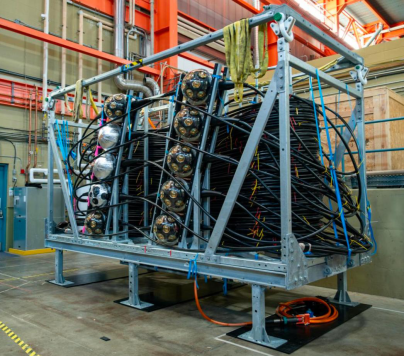
Ocean Networks Canada (ONC). On April 28, the 1 km-long detector line P-ONE-1 was fully assembled and integrated (Figure 1), representing the culmination of nearly three years of coordinated international development and engineering efforts.
Comprehensive final quality-control and communication tests at TRIUMF confirmed that all major detector systems, including PMT readout channels, calibration instruments, timing distribution, and data-network components, are operating as designed.
The construction of P-ONE-1 brought together contributions from institutes across Canada, the United States, and Europe. The subsea backbone cable was developed in close collaboration with McArtney, while optical modules with integrated PMTs (P-OMs) were produced by the Technical University of Munich (TUM). Mainboard electronics were provided by Michigan State University (MSU), interface electronics by the University of Alberta (UoA), and calibration instrumentation by teams from Simon Fraser University (SFU), UoA, and the Institute of Nuclear Physics (INP PAS), Kraków.
Prior to integration, all detector components underwent extensive characterization and acceptance testing at TRIUMF. Particular attention was devoted to mitigating electromagnetic interference (EMI) and validating the mechanical robustness of the final integrated optical modules under realistic operational conditions.
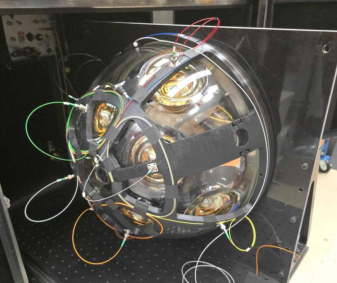
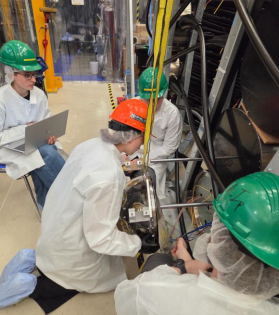
Following successful acceptance tests, all components were sequentially integrated onto the backbone cable and connected to the titanium pressure housings (Figure 2 and 3). After each integration stage, the detector systems were verified through dedicated power, communication, and DAQ functionality tests to ensure stable and reliable operation.
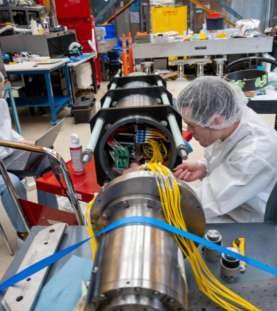
The detector line terminates in the newly developed string Junction Box (sJB), jointly designed and produced by ONC and the P-ONE Collaboration. Final assembly required the careful termination and integration of all power and optical-fiber connections before the sJB was sealed within the TRIUMF cleanroom environment (Figure 4).
In the final assembly step, the sJB was mounted within a dedicated subsea support frame and mechanically integrated with the main P-ONE detector structure (Figure 5). This delicate operation was successfully completed with the support of the TRIUMF operations team.
A final pre-deployment shallow-water wet test is planned for June near Vancouver. Together with ONC, the collaboration aims to deploy P-ONE-1, including the full acoustic calibration infrastructure on the seafloor, by the end of August 2026. Detector commissioning and initial data-taking activities will commence immediately following deployment.
The deployment campaign will also include the installation of a new 30-km subsea cable extension from the original Cascadia Basin node to a new host location outside the recently established marine protected area Tang.ɢ̱wan – ḥačxwiqak – Tsig̱is. To minimize regulatory risks and ensure uninterrupted project progress, the Canada Foundation for Innovation awarded ONC and P-ONE a special one-time infrastructure grant to support the cable relocation. This exceptional out-of-cycle support represents a strong endorsement of the long-term scientific vision of P-ONE.
The next major project stage, the P-ONE Demonstrator, will expand the observatory to up to six detector lines and remains on schedule and within budget. Procurement of long lead-time components, including subsea marine cables, PMTs from Hamamatsu, and titanium structures from McArtney Canada, has already begun.
Detector production facilities across Canada, the United States, and Europe are actively preparing for this next construction phase. Final assembly and system testing of the Demonstrator detector lines are expected to take place at TRIUMF between 2027 and 2028.
